ABOUT
ROBERT ROTH
American
b. 1965, New York
“I’m attempting to capture a transient moment in time—the fringe where land ends and sky and sea collide. That feeling you get when you look up and suddenly everything feels bigger and quieter at the same time—that’s what I’m chasing.”
Robert Roth grew up in Cold Spring Harbor, New York, a historic whaling town where marshlands, inlets, open water, and changing light became part of his earliest visual vocabulary. He began drawing early. Frequent childhood visits to The Metropolitan Museum of Art introduced him to Picasso, Matisse, Degas, and Turner—experiences that remain embedded in his way of seeing.
Roth graduated from the Rhode Island School of Design, where he studied painting. Drawing became a daily discipline, with a sketchbook always by his side, observing moments of the day. He often worked from a single location for hours, allowing his surroundings to reveal themselves slowly. What begins as direct observation gradually shifts. A particular place gives way to a remembered place; light becomes atmosphere; the horizon becomes less a boundary than a threshold.
Landscape is where Roth begins, but it is not where the paintings necessarily end. His work moves between observation, abstraction, and memory, looking for the moment when the physical world begins to loosen. Expansive skies, shifting weather, waterways, and open horizons become structures through which light, space, and emotion can move. Abstracted reflections stream across waterways carving through the land, revealing and obscuring the horizon. The paintings hold a tension between what is seen and what is remembered.
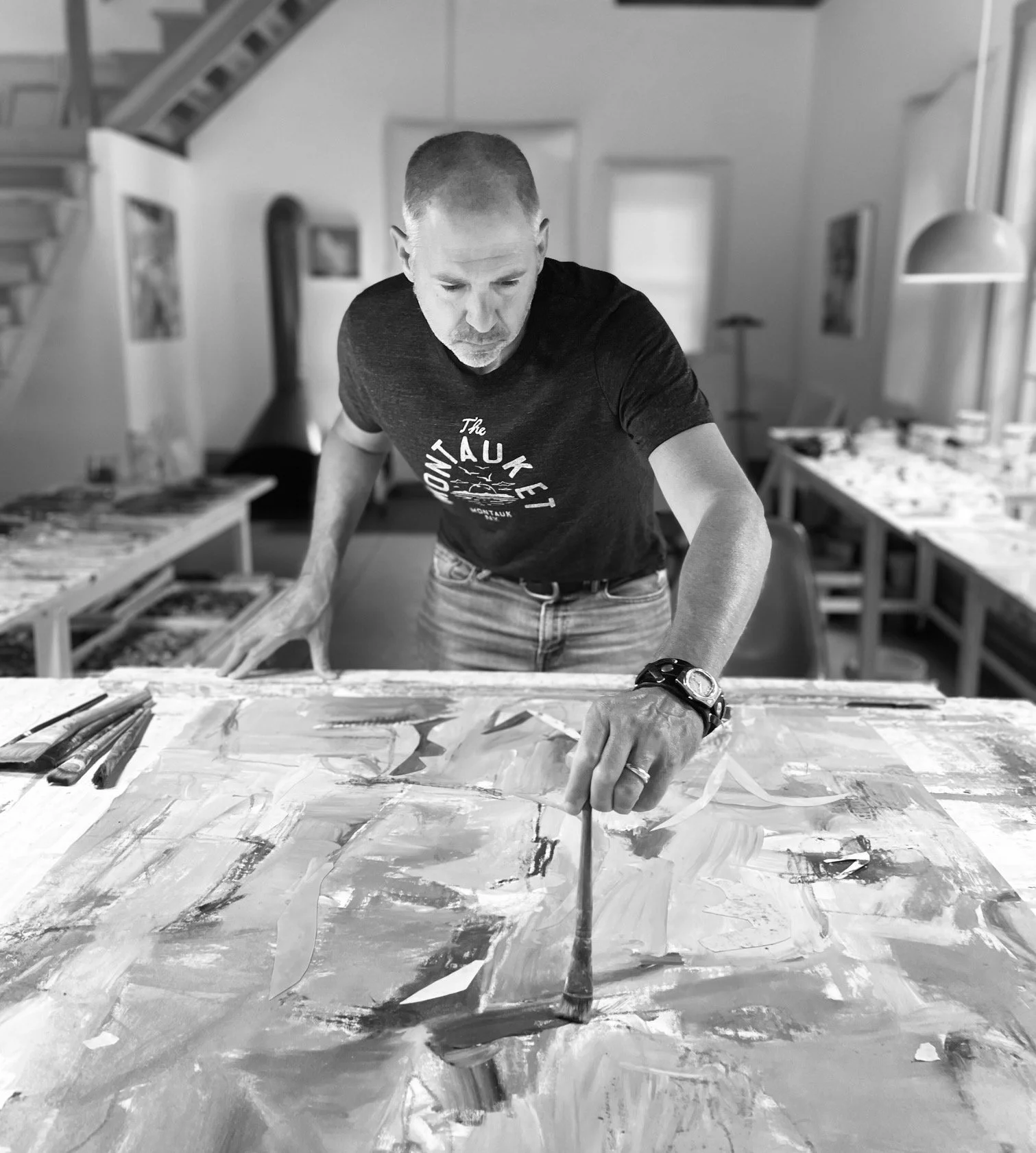
Roth builds his paintings through layers of pigment. Gestural brushstrokes are added, subtracted, dragged, covered, and revealed again. Some passages remain immediate; others carry the evidence of revision. The surface becomes a record of looking—what was there, what changed, and what remained.
At the center of this investigation is the horizon. For Roth, the horizon functions as both anchor and threshold. It is a place where physical space begins to give way to psychological space, where scale shifts and the familiar world can suddenly feel larger, quieter, and less certain.
This investigation extends into Roth’s broader practice. His collages explore geometry, structure, and form through flattened spatial perspectives that nod to Cubism. His still lifes consider proportion, interval, repetition, and the quiet relationships between objects. Across these bodies of work, he is interested in how a composition is built—how forms occupy space, how one element changes another, and how much can be left unresolved. That interest in structure runs through Roth’s family history. His father was a builder, and his great-grandfather was a tinsmith who worked on the crown of the Statue of Liberty. That lineage of making runs quietly through Roth’s approach to layering and mapping a composition.
He derives inspiration from sources as diverse as Abstract Expressionism, Picasso, Matisse, Rothko, Diebenkorn, Motherwell, and Rauschenberg. Exchanges with Alex Katz and Claes Oldenburg further broadened his visual sensibility.
Jazz is a constant presence in Roth’s studio. Charlie Parker, Miles Davis, and John Coltrane often play late into the night. Rhythm, improvisation, repetition, and response find their way into the work.
Roth served as a professor at the Cleveland Institute of Art for several years before returning fully to his studio practice. He and his wife, artist Cheryl Roth, have two daughters. He lives and works in a renovated nineteenth-century farmhouse and barn studio in Northeast Ohio, spending part of each summer on the island of Martha’s Vineyard.
Roth’s paintings are held in public and private collections, including Columbia University, Northeastern University, and the University of Iowa. He has exhibited in New York City and throughout the United States. International collections include those in Australia, Canada, France, Germany, New Zealand, Russia, South Korea, and Hong Kong.
His paintings are represented by Dimmitt Contemporary Art.